

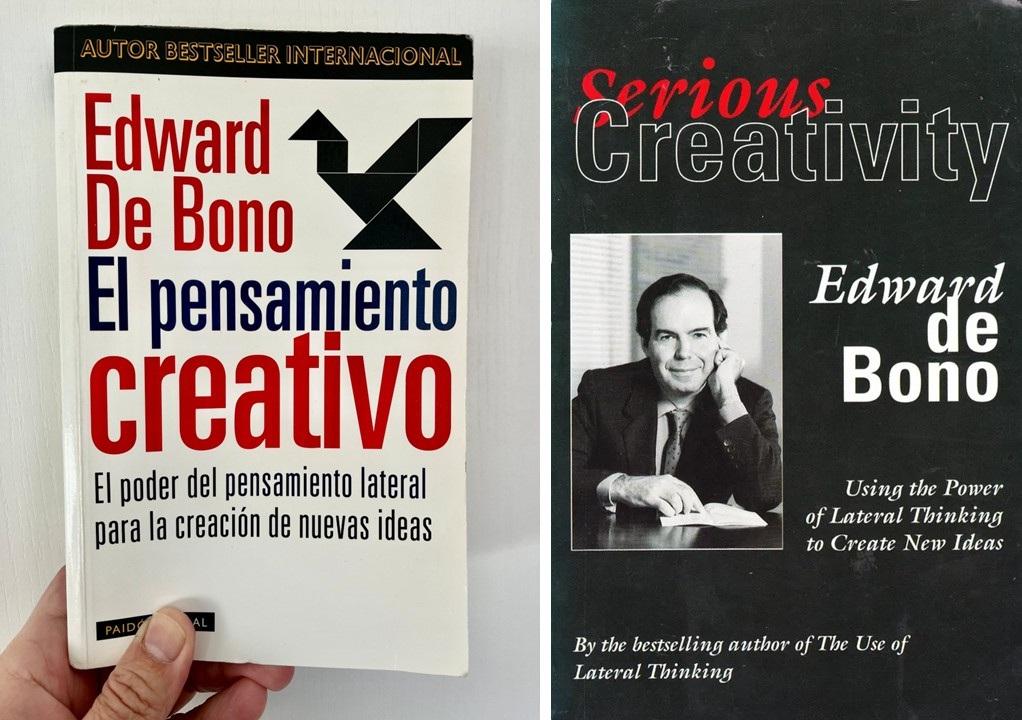

Serious Creativity (The power of lateral thinking for the creation of new ideas) by Edward de Bono
I read this book in 1999, and I admit it changed my way of thinking about creativity and especially about whether we are creative by nature or can train ourselves. Subsequently in my professional development, I have lived and witnessed solutions to truly complicated problems (or at least they seemed so to the group) through creative thinking techniques inspired by Edward de Bono.
Beyond inspiration – In the current ecosystem of Human Resources, “creativity” and “innovation” usually top the lists of most demanded soft skills. However, there is a fundamental disconnect in how organizations address these competencies. Often, “creative talent” is sought after like looking for a needle in a haystack, under the premise that creativity is an innate and mysterious personality trait.
In 1992, Edward de Bono published a first edition of Serious Creativity, a book that should be mandatory reading for any talent director or team leader. His thesis is devastating for the old paradigm: “creativity is not a gift, it is a technical skill“. And as such, it can (and must) be taught, trained, and managed.
p.127 Part II of the book begins with the description of the “Six Thinking Hats: white (information), red (intuition and feeling), black (caution and the logical negative), yellow (logical positive), green (creative effort and creative thinking) and blue (control of the thinking process itself)”.
p.133. “Instead of arguing” (…) “the six hats method allows us to move away from discussion with the purpose of obtaining a more profitable analysis. ‘A’ and ‘B’ can put on the black hat at the same time to discover dangers…”.
What really is Lateral Thinking? Lateral Thinking as a strategic competence to understand the value of this book, it is necessary to break down the central concept that De Bono coined and perfected: “Lateral Thinking”.
- Our education and professional training are based almost exclusively on “Vertical Thinking”.
- This is classical, sequential, and mathematical logic. It functions step-by-step, where each step must be justified by the previous one.
- It is excellent for digging deeper into an existing idea. De Bono uses a very powerful visual metaphor: vertical thinking is like digging a hole.
- If you want to make it deeper and better, you use vertical logic.
- But, and here is the key, “you cannot dig a hole in a different place simply by digging the same hole deeper”.
- Lateral Thinking is the logic needed to change location and start digging elsewhere.
- It does not care about the validity of each individual step, but about the “direction” of thought.
- It is based on the “logic of perception” (how we see the world) instead of the “logic of processing” (what we do with what we see).
What is achieved with this methodology?
The objective of the book is not to turn employees into artists, but to endow the company with “serious” and systematic creativity. By applying lateral thinking, organizations achieve:
Breaking patterns of continuity
The human brain is designed to be efficient, creating routines and fixed patterns. This is good for survival, but terrible for innovation. Lateral thinking offers an escape route from those established patterns.
- Generation of real value: It is not about being “witty” or “different for the sake of being different”. De Bono insists that a creative idea must have value. Lateral thinking seeks solutions that are logical a posteriori, even if they didn’t seem so at first.
- Economy of thought: It prevents teams from getting stuck arguing about who is right (vertical thinking) and redirects them to explore what other possibilities exist.
The mechanics: How is creativity worked on?
What makes Serious Creativity a jewel for talent development is that it offers a practical framework. De Bono demystifies chaotic “brainstorming” and proposes deliberate tools:
The use of Provocation (PO): Perhaps the most radical technique. It consists of formulating an idea that we know is false or impossible (e.g., “Cars should have square wheels”) to use as a springboard toward viable ideas. In normal logic, this is discarded. In lateral thinking, it is used under the “PO” operation. We do not seek the truth, we seek movement. That absurd idea serves as a springboard to reach a new idea (e.g., adjustable suspension).
- The Random Entry: A technique to connect the current problem with a stimulus that has nothing to do with it (a random word in a dictionary, an object in the room). This forces the brain to build new neural connections, leaving its usual “groove”.
- The Concept Challenge: Asking “why do we do this like this?” not from criticism (which makes people defensive), but from pure curiosity, to see if there are alternative paths that have been ignored due to inertia.
3 Keys for Talent Management
Upon finishing reading this work, three fundamental lessons emerge for any human capital strategy:
Innovation is discipline, not luck: Let’s stop waiting for the muses. A team trained in De Bono’s techniques can generate innovative ideas on a Monday at 9.00 in the morning on demand.
- The leader’s role changes: The manager stops being the judge who approves or rejects ideas and becomes the facilitator who orchestrates the use of the tools. Their job is to ensure that the team does not fall into premature judgment.
- Training vs. Selection: Instead of obsessing over hiring “geniuses”, companies get a higher return on investment by teaching their current staff how to think. They already have the processing capacity; they just need the software (the method) to process information laterally.
p. 279. “Basic types of thinking” (1) realization; (2) improvement; (3) plateau; (4) organizational.
Recommendation by Jose Ramon Largo (CEO at RAMPALLO Consulting S.L.) on the edition by PAIDOS PLURAL, published in 1999. ISBN 84-493-0713-9


0 Comments