

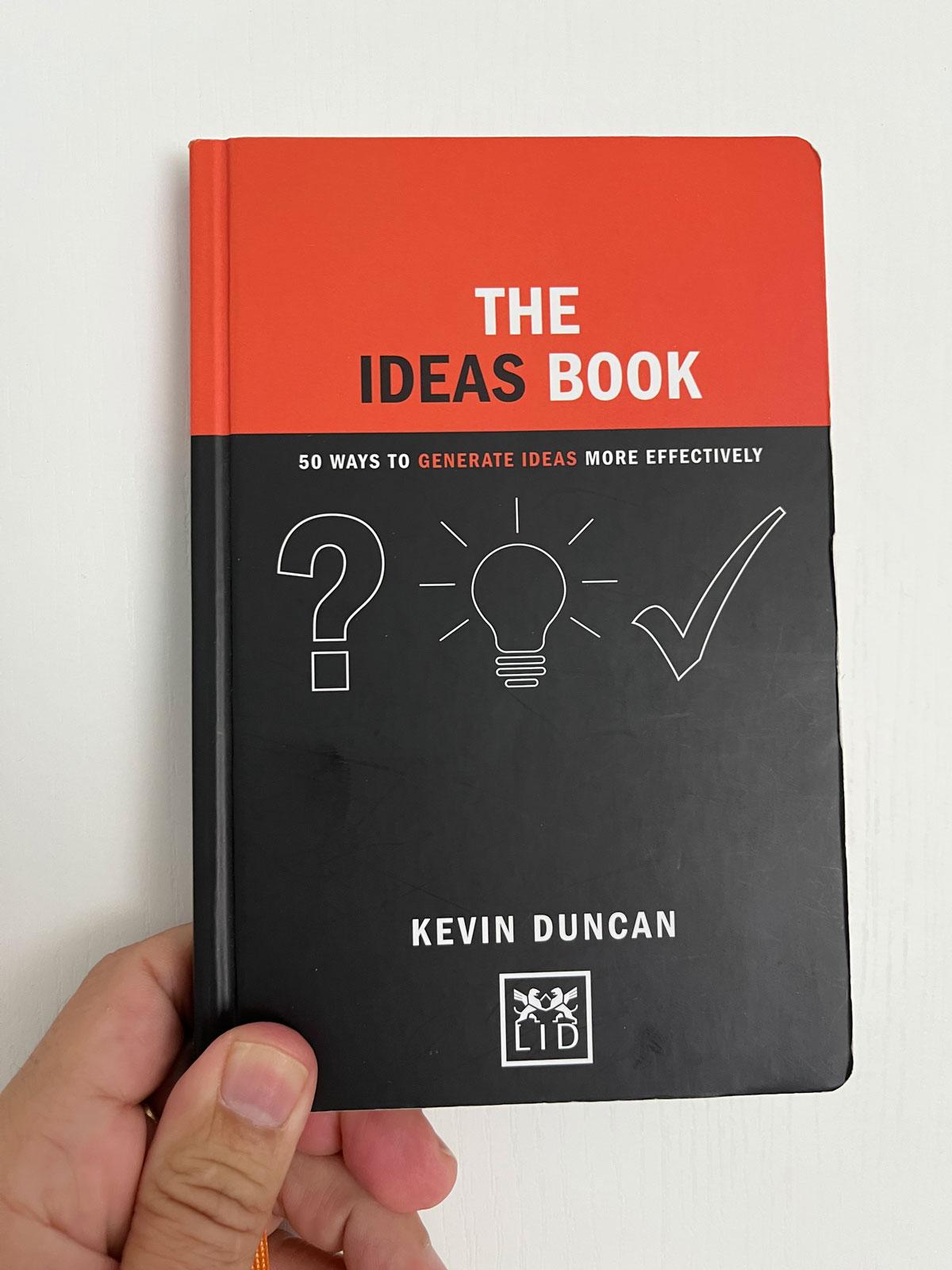

At various points throughout my professional career, I have led—and continue to lead—problem-solving sessions and processes (applying methodologies such as DMAIC, A3, 8D, etc.), as well as initiatives to identify new business opportunities. Every single one of these methodologies includes, at the very least, a stage dedicated to idea generation. I have researched this topic extensively, and out of all the books I have read, I highly recommend this one. It is practically a handbook: easy to read, easy to remember, convenient to bring to meetings, and, above all, highly effective for frequent consultation.
As professionals operating within continuously evolving ecosystems—from digital marketing and talent configuration to heavy industry and energy transitions—we implicitly recognize that ideas represent the core fuel of competitive advantage. However, inside corporate boards, we frequently execute the error of relegating innovation to chaotic, unstructured brainstorming sessions where internal power dynamics mute diverse talents or dissolve the overarching strategic focus. Kevin Duncan’s The Ideas Book—a seasoned business advisor and marketing expert—systematizes the creative workflow through the deployment of visual thinking.
Duncan thoroughly deconstructs creativity. He avoids treating it as an innate, divine gift reserved for an elite group of “creative types”; instead, he repositions it as a clear operational discipline driven by precise preparation, strict methodology, and structured visual frameworks. It serves as an essential field guide for executives who need to unlock their teams’ output and craft precise, bulletproof lines of arguments for corporate steering committees.
I. The Core Thesis: Innovation as a Disciplined Pipeline
The framework posits that high-value commercial ideas do not spring from abstract chaos, but emerge through a sequential, deliberate design.
- The Trap of Boundless Ideation: Dropping a complex corporate problem onto a team inside a blank room without structural rules leads directly to cognitive paralysis or derivative, linear outputs. The brain requires constraints and clear visual stimuli (“thinking inside the box with new parameters”).
- The Dominance of Visual Thinking: Utilizing diagrams, mental maps, and spatial matrices forces immediate cognitive synthesis. It strips away standard executive jargon (business bullshit) and allows teams to map out logical gaps and hidden commercial connections text-heavy files conceal.
- The Rule of Distillation: An idea carries zero organizational asset value until it is translated into a highly refined point of view and a razor-sharp corporate value proposition.
II. Anatomy of the Ideation Architecture (The 5-Phase Model)
Duncan segments intelligent, scalable corporate innovation into five critical, interdependent stages:
- Preparation: Diagnosing the systemic bottleneck, gathering contextual market realities, and defining strict operating constraints.
- Generation: Leveraging the first wave of 30 tailored visual diagrams to bypass cognitive habits and spark non-obvious alternatives.
- Deepening (More Ideas): Deploying advanced techniques to combine, expand, and cross-pollinate initial concepts into robust systems.
- Judgment (Evaluation): The critical operational filter. Assessing technical viability, timeline feasibility, and definitive financial ROI.
- Enactment (Execution): The transition to project management. Converting a visual architecture into clear milestones and cross-departmental accountability.
III. Cross-Sectorial Impact Matrix
For executive strategists across the Rampallo matrix, Duncan’s methodology transforms operational capabilities:
| Professional Domain | Strategic Impact | Practical Application (The Ideas Book Blueprint) |
|---|---|---|
| Marketing & Strategy | Saturated B2B and B2C channels demand highly memorable value propositions. Strategies must be visually stress-tested before capital deployment. | Deploy the book’s “Persuasive Line of Argument” frameworks to structure commercial pitches, ensuring they are tightly engineered and fluff-free. |
| Human Resources & Leadership | Legacy group ideation is fundamentally skewed toward extroverted or dominant voices, systematically silencing deep analytical talent. | Overhaul innovation workshops. Replace open verbal discussions with silent, diagram-based individual sprints, merging inputs analytically on shared visual boards. |
| Industry, Energy & Operations | Navigating intricate technical challenges (such as circular supply chains or energy efficiency overhauls) requires breaking out of default legacy operating frameworks. | Utilize Duncan’s “Reverse Thinking” models: instead of asking how to fix a systemic bottleneck, map out exactly how to cause it to expose hidden baseline vulnerabilities. |
IV. The Executive Takeaway
For corporate leadership, Kevin Duncan’s ultimate takeaway is that efficient innovation is not an occasional, unstructured corporate retreat; it is a high-leverage operational workflow that must be managed with the same rigorous governance applied to financial audits or supply chains. Disciplined creativity requires moving away from text-heavy briefs and circular meetings toward an agile ecosystem of visual frameworks—where ideas are rigorously prepared, methodically generated, and brutally evaluated against corporate ROI before consuming institutional resources.
Recommendation by Jose Ramon Largo (CEO at RAMPALLO Consulting S.L.) on the edition by LID Publishing Ltd, published in 2014. ISBN 978-1-907794-57-5


0 Comments