

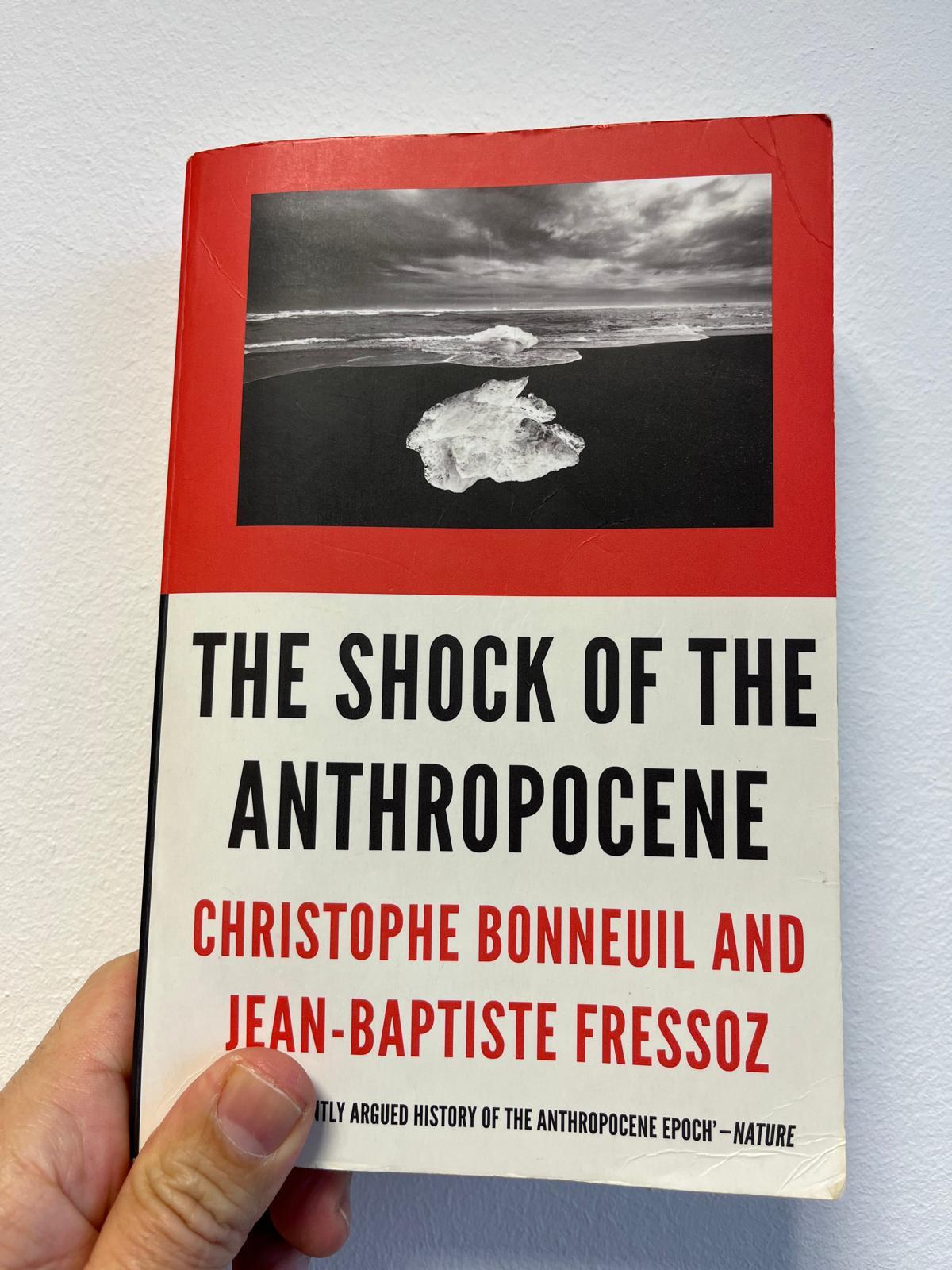

The Shock of the Anthropocene
Authors: Christophe Bonneuil y Jean-Baptiste Fressoz
As a professional interested in contemporary energy and environmental literature, I often come across books that treat the “Anthropocene”—the proposed geological epoch defined by human impact—as a purely scientific revelation. They tell a familiar story: humanity destroyed the Earth blindly, scientists finally “woke us up,” and now we must rely on technology to save us. The book The Shock of the Anthropocene destroys this narrative.
Page 14: “British geographers Simon Lewis and Mark Maslin have recently proposed starting the Anthropocene with the European conquest of America.”
Bonneuil and Fressoz, two French historians of science, have produced a work that is not simply a summary of our ecological crisis, but a radical rewriting of its history. It is a dense, polemical, and brilliantly argued corrective to the “official” history of how we got here.
Page 33: “In the Anthropocene, it is impossible to hide the fact that ‘social’ relations are full of biophysical processes, and that the various flows of matter and energy running through the Earth system at different levels are polarized by socially structured human activities.”
Page 55: “The International Union for Conservation of Nature now presents nature as ‘the largest enterprise on Earth’.”
Page 56: “Anthropocene in four indicators: (1) concentration of carbon in the atmosphere (…) (2) global mean temperature (…) (3) the percentages of the land surface that are anthropized, and (4) the millions of tons of nitrogen and potassium in circulation.”
I. The “Official” Narrative: A Convenient Fable
The book begins by dissecting what the authors call the “fable of awakening.”
- The Fable: We are told that, for two centuries, humanity burned fossil fuels and destroyed nature because we were unaware of the consequences. Only recently (thanks to modern science) have we “realized” our mistake.
- The Critique: Bonneuil and Fressoz argue that this is historically false. They demonstrate that scientists, intellectuals, and citizens in the 19th and early 20th centuries were aware of deforestation, climate alteration, and resource depletion.
- The Consequence: By claiming we were “blind,” the official narrative absolves past industrialists and politicians of responsibility. It positions the Anthropocene as an accident rather than a choice.
Page 101: “The bad news is that, if history teaches us anything, it is that there has never been an energy transition. There was no shift from wood to coal, then from coal to oil, and then from oil to nuclear. The history of energy is not one of transitions, but rather of successive additions of new primary energy sources.”
Page 157: The “consumer society” (…) Required a transformation of values: repairing, economizing, and saving were presented as old-fashioned habits harmful to the national economy, while repeated and ostentatious consumption, fashion, and obsolescence became respectable goals.
II. Who is the “Anthropos”? (The Critique of “Us”)
One of the book’s most powerful moves is its attack on the word “Anthropocene” itself. The term implies that “Man” (a unified and undifferentiated humanity) is responsible for climate change.
Page 167: “As in all industrialized countries, the consumerism that fueled strong economic growth was made possible by the extraction of the planet’s finite natural resources and unequal exchange with raw material producing countries.”
- The authors argue that a subsistence farmer in Bangladesh and the CEO of an oil company in Texas are not equally responsible for this geological shift.
- By blaming “Humanity,” we hide the specific political and economic systems (Capitalism, Imperialism, Militarism) that actually drove the destruction.
Page 197: “The historical problem, therefore, is not the emergence of an ‘environmental consciousness’ but rather the opposite: understanding the schizophrenic nature of modernity, which continued to view humans as products of their environment while simultaneously allowing them to damage and destroy it.”
III. Seven Ways to Retell the Story
If the story of “blind humanity” is a lie, what is the truth? The authors propose seven alternative historical lenses (or “scenes”) to explain the current epoch:
| The Lens | What It Reveals |
|---|---|
| The Thermocene | A political history of CO2. Challenges the idea of “energy transitions” (we never replaced wood with coal; we simply added new energies on top of old ones). |
| The Thanatocene | The “Epoch of Death.” Examines the role of the military-industrial complex. Modern warfare accelerated ecological destruction through testing, chemical warfare, and massive resource mobilization. |
| The Phagocene | The “Epoch of Consumption.” A look at how consumerism was manufactured. The “throwaway culture” was not natural human behavior; it was designed by corporations to avoid market saturation. |
| The Phronocene | The “Epoch of Reflexivity.” This contradicts the myth of “we didn’t know.” Documents the long history of environmental warnings that were ignored or suppressed. |
| The Agnotocene | The “Epoch of Ignorance.” How ignorance was constructed. The authors detail how industries (such as lead, tobacco, and later fossil fuels) actively worked to manufacture doubt. |
| The Capitalocene | A history centered on how the logic of capital accumulation (cheap nature, cheap labor) is the true driver of the crisis, not just “human nature.” |
| The Polemocene | The “Epoch of Struggle.” A history of the resistance movements that tried to stop this destruction but were defeated. |
IV. The Danger of “Geopower”
The final section of the book warns against the technocratic solutions currently being proposed. The authors identify a new form of power they call “Geopower”: the idea that the Earth is a machine that must be managed by scientists and engineers.
- They are deeply critical of Geoengineering (manipulating the climate to offset warming).
- They argue that this is the ultimate arrogance: having failed to control our economies, we now believe we can control the planet’s thermostat.
Page 266: The author highlighted the key point: “…In the second half of the 20th century, the model of ‘regulated forestry’ (born in Germany and spread by the École Forestière de Nancy) became universalized…” as the beginning of a real problem.
Page 289: “The Anthropocene is here (…) Therefore, we have to learn to survive, that is, to leave the Earth habitable and resilient, limiting the frequency of catastrophes and the sources of human misery.”


0 Comments